
Globe Democracy | Sunday Article — 18 October 2026
By Engr. Ghulam Habib
Introduction
Affordable AI education can help make learning accessible to everyone. Education is not a luxury reserved for wealthy families; it is a fundamental opportunity that every human being deserves, regardless of age, nationality, gender, financial position, or geographical location.
For centuries, millions of talented people have been deprived of education because of poverty, expensive institutions, limited teachers, and inadequate educational facilities.
UNESCO recognises education as a fundamental human right and promotes inclusive, equitable and quality education for all.
Today, artificial intelligence (AI) offers an extraordinary opportunity to reduce these barriers. AI-powered educational tools can help students learn independently, assist teachers, translate learning materials, and make quality education more affordable.
The greatest promise of AI in education is not to replace teachers or universities, but to make knowledge more accessible to humanity.
1. Ten major benefits of AI in education
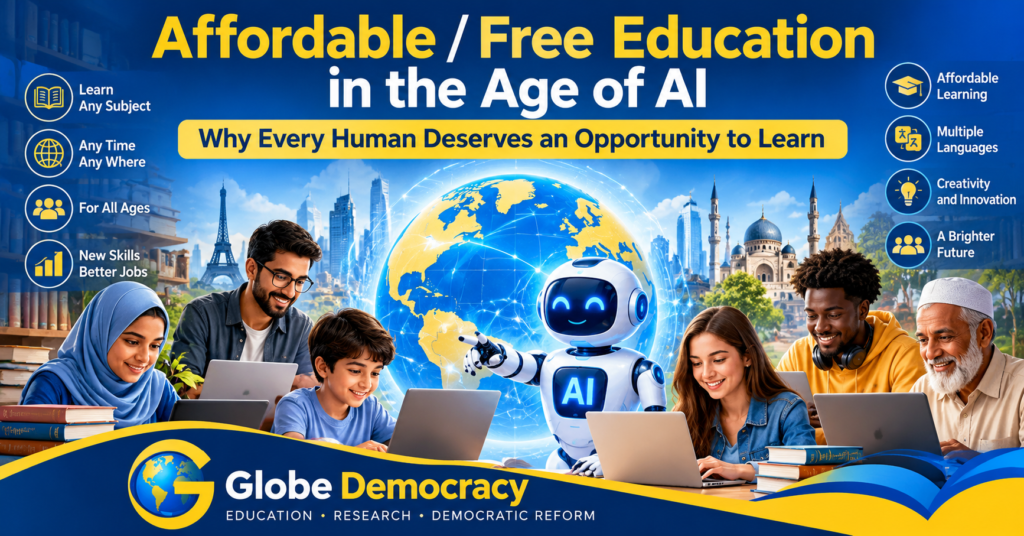
1. Affordable learning for everyone
AI-powered educational assistants can explain lessons, generate practice questions, and provide learning support at little or no direct cost through certain free services. This can reduce dependence on expensive private tuition, although internet access and devices still carry costs.
2. Personalised education
Every student learns differently. AI can adjust explanations, examples, exercises, and difficulty levels according to individual learning needs. A struggling student can receive simpler explanations, while an advanced learner can explore more challenging material.
3. Education available 24 hours a day
Unlike traditional classrooms, AI learning assistants can be available at any hour. Students can study after work, during evenings, or whenever their personal circumstances allow.
4. Learning without age restrictions
AI can support schoolchildren, university students, working professionals, retired people, and senior citizens. A person who missed formal education earlier in life can begin learning again.
5. Multilingual learning opportunities
AI can explain educational subjects in English, Urdu, Arabic, Bengali, Hindi, and many other languages. This helps learners understand difficult concepts in languages they know best, although translations should be checked for accuracy.
6. Better support for teachers
Teachers can use AI to prepare lesson plans, develop quizzes, create classroom activities, and identify topics requiring additional explanation. This allows them to devote more attention to mentoring and student development.
7. Practical skills and employment opportunities
Students can use AI to learn computer programming, digital marketing, accounting, engineering fundamentals, business management, communication, and entrepreneurship. Such learning can improve employability when combined with practical experience and recognised qualifications.
8. Education for rural and underserved communities
People living far from colleges and universities can access digital learning materials without relocating. Downloadable resources and low-bandwidth learning options can extend these benefits to communities with limited connectivity.
9. Continuous assessment and improvement
AI can generate practice tests, explain mistakes, and provide immediate feedback. Students can identify weaknesses and practise repeatedly before taking formal examinations.
10. Encouraging creativity, research, and innovation
AI can help learners brainstorm ideas, compare approaches, simulate problems, and explore new fields. Used responsibly, it can strengthen curiosity, critical thinking, and innovation rather than merely encouraging memorisation.
2. How AI can reduce educational inequality
A student in a remote village may possess the same intelligence and determination as a student studying at an expensive university. Yet their educational opportunities can differ enormously.
AI can help narrow this gap by providing accessible explanations, interactive practice, and learning materials beyond the boundaries of conventional classrooms.
Consider a young person who wants to learn electrical engineering but cannot afford private tuition. An AI assistant can explain Ohm’s law, guide calculations, develop circuit exercises, and help the learner understand basic design principles.
Similarly, a small-business owner can learn accounting, marketing, and digital skills without enrolling in an expensive full-time programme.
These opportunities do not eliminate the need for qualified teachers, laboratories, accredited examinations, or practical training. They do, however, provide valuable starting points for people who might otherwise have no access to learning.
3. The role of Globe University
The educational vision of Globe Democracy and Globe University is based on a simple principle:
Knowledge should reach people, rather than forcing people to overcome financial and geographical barriers to reach knowledge.
Globe University’s proposed affordable education model seeks to support students through online courses, professional learning, technical education, and accessible study opportunities.
Its objectives include expanding access to education, supporting lifelong learning, encouraging practical skills, and reducing unnecessary financial burdens on students.
AI can become an important supporting technology in this mission by helping learners understand difficult subjects, practise independently, and develop confidence.
The long-term objective should be to combine accessible digital education with responsible academic supervision, reliable assessments, and appropriate institutional recognition.
4. AI education can strengthen national economies
Affordable AI-supported education is not only beneficial for individual students. It can also contribute to national development.
When more people acquire useful skills, countries can benefit from a stronger workforce, improved entrepreneurship, technological innovation, and greater economic participation.
For developing countries such as Pakistan, Bangladesh, India, and many African nations, AI-supported learning offers an opportunity to expand educational access without relying exclusively on the construction of expensive new institutions.
Governments could support this transformation by providing affordable internet, public digital learning centres, teacher training, and open educational resources.
However, the economic benefits depend on the quality of education, the availability of employment opportunities, and students’ ability to apply what they learn.
5. Responsible AI education: Important challenges
AI is powerful, but it is not perfect. Educational institutions and students must understand its limitations.
AI systems can produce incorrect information, unreliable references, or misleading answers. Students must therefore learn to verify important information through reliable textbooks, qualified teachers, and credible research sources.
Other challenges include unequal internet access, student data privacy, excessive dependence on technology, and the temptation to submit AI-generated work without genuine understanding.
AI should develop human intelligence, not replace independent human thinking.
Responsible AI education must promote honesty, creativity, critical thinking, and respect for human values.
6. A global call for affordable and free education
The world should recognise education as an investment in humanity rather than merely a commercial service.
Governments, universities, technology companies, charitable organisations, and educators should work together to make essential learning resources affordable and, wherever possible, free.
A practical global strategy could include publicly accessible AI learning assistants, multilingual educational materials, free foundational courses, low-cost technical programmes, and financial assistance for disadvantaged students.
Technology alone cannot guarantee equal opportunity. But when combined with public commitment, competent teachers, and effective educational policies, AI can help bring meaningful learning opportunities to millions more people.
Conclusion: Education belongs to humanity
The age of artificial intelligence presents an opportunity to rethink how education is delivered and who can access it.
A person’s future should not be determined solely by family income, birthplace, age, or ability to pay university fees.
AI can help reduce educational costs, support teachers, personalise learning, develop professional skills, and open new pathways for lifelong education.
The mission of Globe University reflects this wider aspiration: to make useful knowledge and educational opportunities available to people across the world.
Every human being deserves the opportunity to learn. Every talented mind deserves the opportunity to develop. And every society benefits when education becomes more accessible.
Engr. Ghulam Habib Globe Democracy — Education, Research and Democratic Reform www.globedemocracy.org